When a critical component starts showing signs of wear, the default instinct for many maintenance and operations teams is to replace it. Order the part, wait for delivery, install it, and get back to production. On the surface, that seems straightforward. But the true cost of that decision, when you factor in lead times, part pricing, and production downtime, often tells a different story. Industrial chrome plating has been solving this exact problem for decades, and for high-wear components in demanding environments, it consistently outperforms outright replacement in both cost and performance.
This article breaks down why that is, what the process actually involves, and when plating makes more sense than buying new.
The Real Cost of Replacing Worn Components
Table of Contents
Replacement sounds simple, but the economics get complicated quickly.
Start with procurement. For standard off-the-shelf parts, lead times may be manageable. But for custom shafts, hydraulic cylinder rods, rollers, rams, or precision-machined components, you could be looking at weeks, sometimes longer. Every day a machine sits idle waiting on a part is a day of lost production.
Then there is the part cost itself. OEM components are expensive. For heavily engineered or specialty items, the price can be substantial, especially when you factor in the full lifecycle, meaning this is not a one-time cost. Wear happens again. You will be back in the same situation.
There is also the installation side. Swapping out a major component is labor-intensive. Depending on the machine, that work could take a skilled crew the better part of a day, or longer. Add it all up, including the labor, downtime, part cost, and expedite fees if you need the part fast, and a single replacement event can run well into the thousands.
Plating changes that equation significantly.
What Industrial Chrome Plating Actually Does
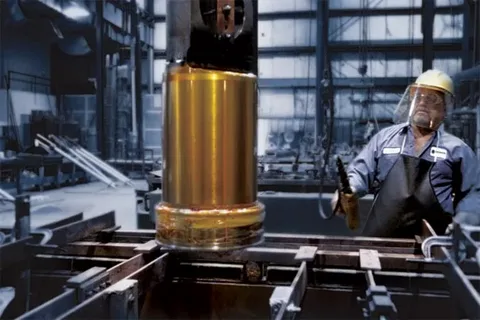
Hard chrome plating is an electroplating process that deposits a layer of chromium onto a metal substrate. The result is a surface that is exceptionally hard, highly resistant to wear and corrosion, and capable of reducing friction under load.
The Rockwell hardness of a hard chrome coating typically falls between 65 and 70 HRC. That is harder than most tool steels. This hardness directly translates into extended service life for components that operate under abrasion, sliding contact, or repeated impact.
What makes this particularly valuable for worn components is that the chrome can be applied to a surface that has already seen wear. A hydraulic rod that has lost material due to friction can be brought back to its original dimensions, or built up to spec, through a combination of plating and precision grinding. The component does not need to be scrapped. It can be restored.
This is not a patch job. When done correctly by a qualified plating facility, the restored component performs comparably to a new one, and in some cases, better, because the base material has already proven its structural integrity in service.
Applications Where Plating Makes the Most Sense
Not every component is a good candidate for plating, but there is a wide range of industrial applications where it delivers clear advantages.
Hydraulic cylinder rods and pistons. These are among the most common applications for hard chrome plating. Rods see constant reciprocating motion, contact with seals, and exposure to contaminants. A worn or scored rod can be cleaned up, built back to dimension, and returned to service in a fraction of the time it would take to source a replacement.
Rollers and shafts. In mills, presses, and forming equipment, rollers and shafts take a beating. Wear at contact points is inevitable. Plating the worn surfaces restores the geometry and adds a hardened layer that extends the time between the next service interval.
Pump components. Plungers, pistons, and housings in industrial pump applications benefit from the corrosion resistance and low friction characteristics of hard chrome. For environments involving chemical exposure or high fluid pressure, the surface protection is particularly valuable.
Dies and molds. Tooling takes wear from every cycle. A plated surface resists the abrasion and heat that degrade uncoated tooling, extending the life of expensive dies and reducing the frequency of tooling replacement.
Agricultural and construction equipment. Cylinders, shafts, and structural components in heavy equipment see some of the most demanding service conditions anywhere. Field exposure, load cycling, and environmental contamination accelerate wear. Plating these components during a scheduled repair extends their usable life without requiring a full replacement.
The Turnaround Advantage
One argument for replacement is speed. If you have a part on the shelf, you can install it today.
But most operations do not carry extensive spare parts inventories for every critical component. And when a specialized part is not in stock, the turnaround on a replacement order can stretch days or weeks.
An experienced industrial plating facility can often process a component and return it faster than a replacement part can be sourced, especially for non-standard or custom-engineered items. For operations that run on tight schedules, that matters.
The key is working with a plating provider that understands urgency and has the capacity to move efficiently without cutting corners on quality. Lead time should be part of the conversation when you evaluate a vendor.
Quality Control Is the Differentiator
The performance of a plated component depends heavily on the quality of the process. Adhesion, coating uniformity, dimensional accuracy after grinding, and surface finish all matter.
ISO 9001 registration is a meaningful indicator here. It reflects that a facility operates under documented quality management processes, with controls in place at each stage of production. For B2B buyers sourcing plating work, that kind of third-party validation provides a measurable level of assurance.
When evaluating a plating provider, ask about their quality documentation, inspection processes, and how they handle components that do not meet specification. A shop that takes quality seriously will have clear answers.
Repair vs. Replacement: A Framework for Decision-Making
There is no universal rule that says plating always wins. The right answer depends on the specific situation. Here is a practical framework for thinking through the decision.
Consider plating and restoration when:
- The base material is structurally sound and not cracked or compromised
- The component geometry can be restored to specification through plating and grinding
- Lead time for a replacement part is longer than the plating turnaround
- The replacement part cost significantly exceeds the cost of restoration
- The component is a recurring wear item with predictable service intervals
Consider replacement when:
- The component has structural damage beyond surface wear
- The base material is fatigued or otherwise unsuitable for continued service
- The part is a standard, low-cost item that is readily available
- Dimensional tolerances cannot be reliably restored through plating
For most high-wear, high-value industrial components, the calculus favors restoration. The cost savings are real. The turnaround is often faster than assumed. And when the work is done right, the performance is there.
The Bottom Line
Replacing worn components is sometimes the right call. But for the majority of high-wear industrial parts, it is not the only option, and frequently not the best one. Hard chrome plating restores components to working condition, adds a hardened wear surface, and gets equipment back in service at a fraction of the cost of replacement.
For operations teams focused on reducing downtime and controlling maintenance costs, understanding what plating can and cannot do is a practical advantage. The next time a component shows up on the wear list, it is worth asking whether restoration is the smarter move before placing a replacement order.