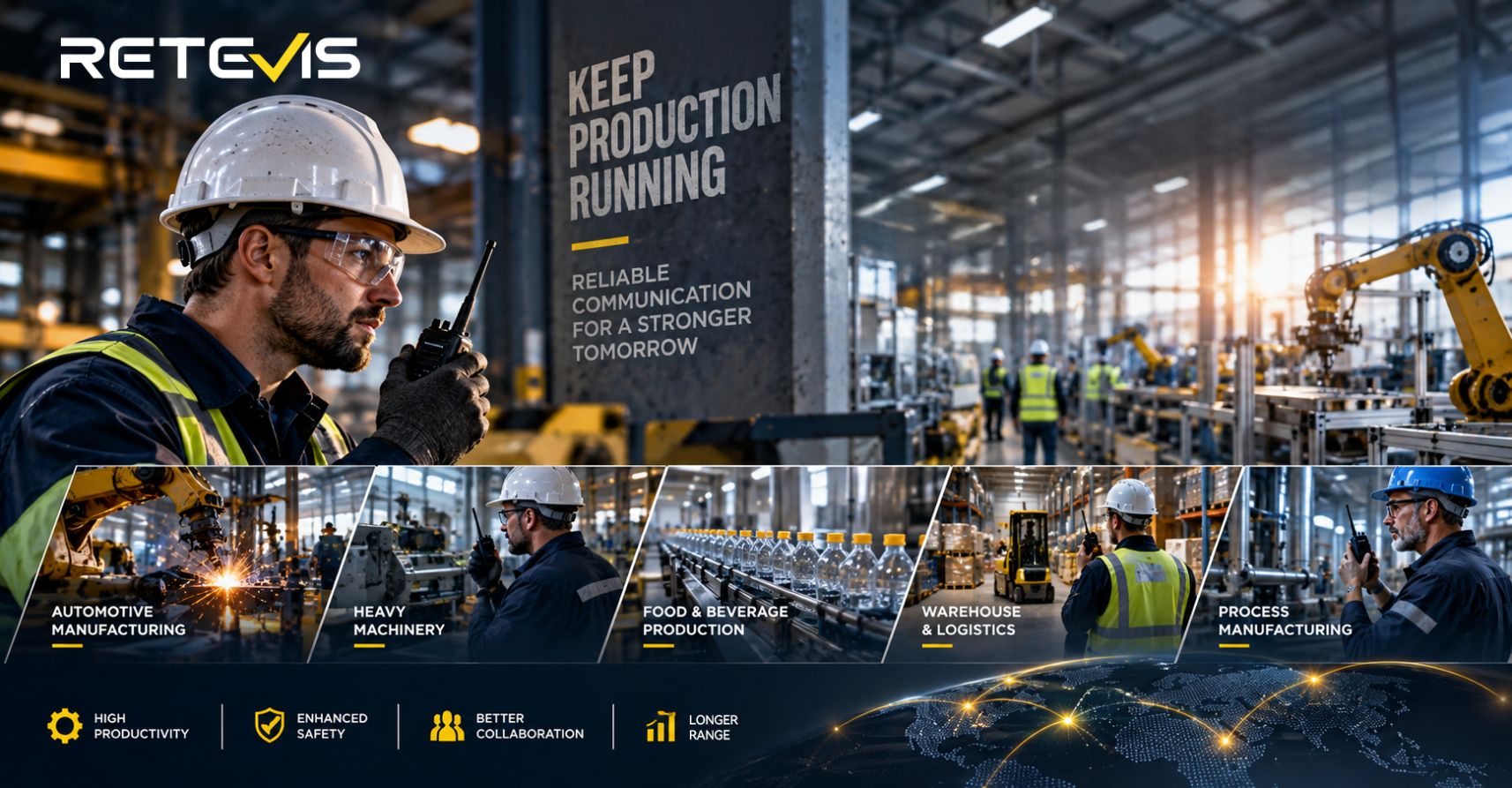
Factories need more than instant communication. Noise, machinery, distance and multiple work zones make reliability an operational requirement.
A modern manufacturing facility is a network of people, machines and processes that need to stay coordinated.
Production operators may need maintenance support. Warehouse teams need to coordinate material movement. Supervisors move between production areas. Safety personnel may need to reach multiple teams quickly.
When communication slows, operations can slow with it.
That makes two-way radios for manufacturing more than convenience devices. They become part of the operating workflow.
Why Manufacturing Communication Is Difficult
Table of Contents
Manufacturing facilities create several communication challenges at once.
Machinery generates background noise.
Steel structures and equipment can affect radio signals.
Workers may be distributed between production, maintenance, warehouses and loading areas.
And communication equipment may face dust, impacts and continuous handling across long shifts.
This creates four practical requirements:
Clear. Durable. Connected. Supported.
Clear Communication Around Machinery
In a quiet office, understanding a voice message is relatively easy.
On a factory floor, it can be much more difficult.
Motors, conveyors, tools and production equipment can overwhelm speech. That means manufacturers evaluating industrial two-way radios should consider audio performance and noise reduction alongside range.
The objective is not simply transmission.
It is understanding.
Equipment Designed for Work
Manufacturing equipment also needs to tolerate the environment.
RETEVIS’s RB48 industrial radio series provides one example of a rugged approach, including IP67 protection and 19 environmental reliability tests under the MIL-STD-810H testing framework.
These characteristics address conditions such as dust, water, vibration and physical handling that can be part of everyday industrial work.
When Manufacturing Communication Becomes More Complex
A small production team and a large manufacturing facility do not require identical communication systems.
As operations expand, companies may need separate communication groups for production, maintenance, logistics and security.
Facilities may also experience coverage challenges between buildings, warehouses or distant operating areas.
At that point, manufacturers should stop thinking only about individual radios and start thinking about the factory communication system.
Digital radios can support more structured communication, while repeaters can extend radio coverage when the facility requires it.
Start With the Operation
Before selecting radios, manufacturing leaders should map:
- who needs to communicate;
- where teams work;
- where noise is highest;
- where physical barriers exist;
- which messages are operationally critical; and
- where direct radio coverage may struggle.
This produces a communication system designed around the factory rather than a factory forced to adapt to the radio.
After 16 years of working across different communication environments, this scenario-first approach increasingly defines RETEVIS’s direction.
Different operations have different challenges. Reliable communication begins by understanding them.